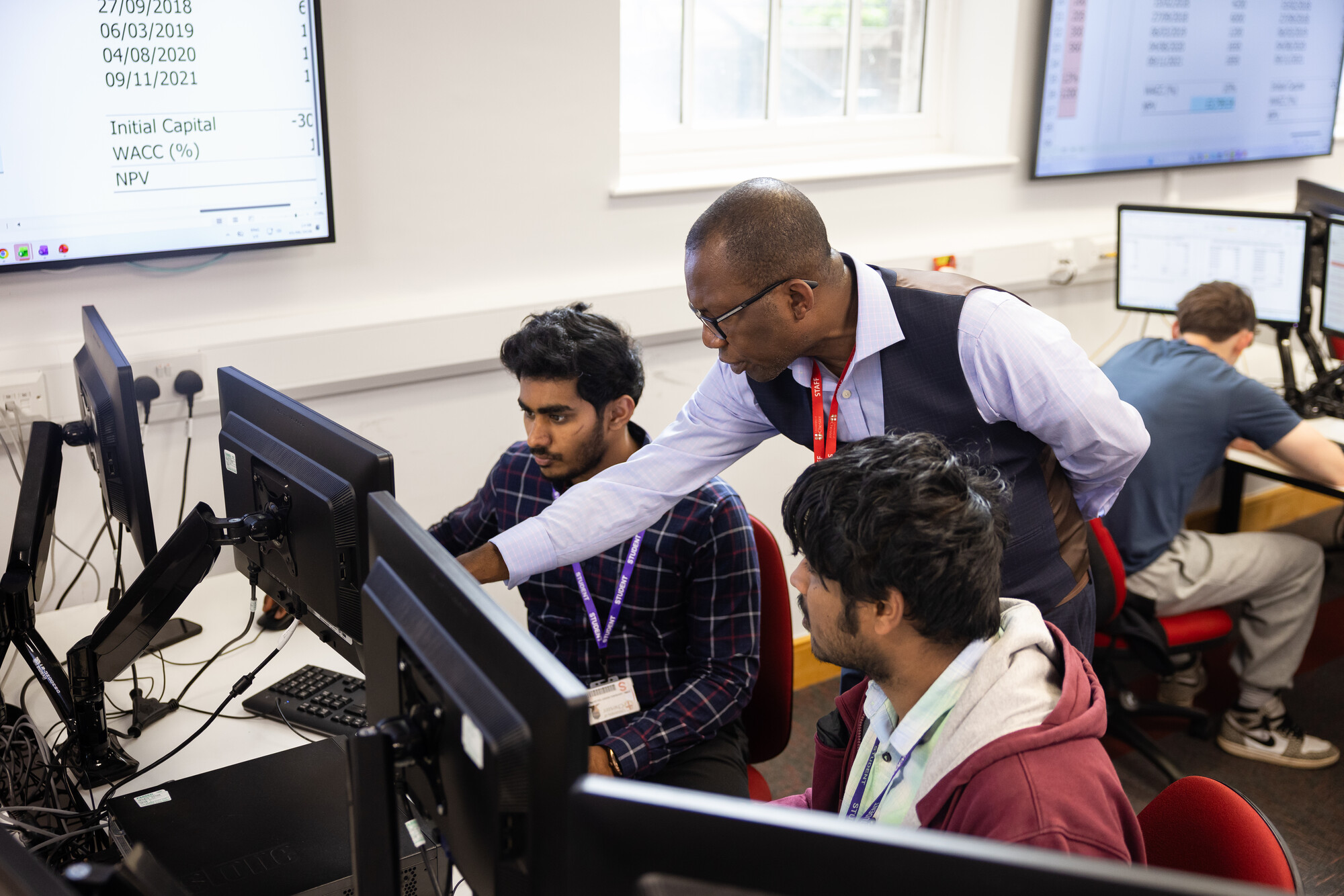

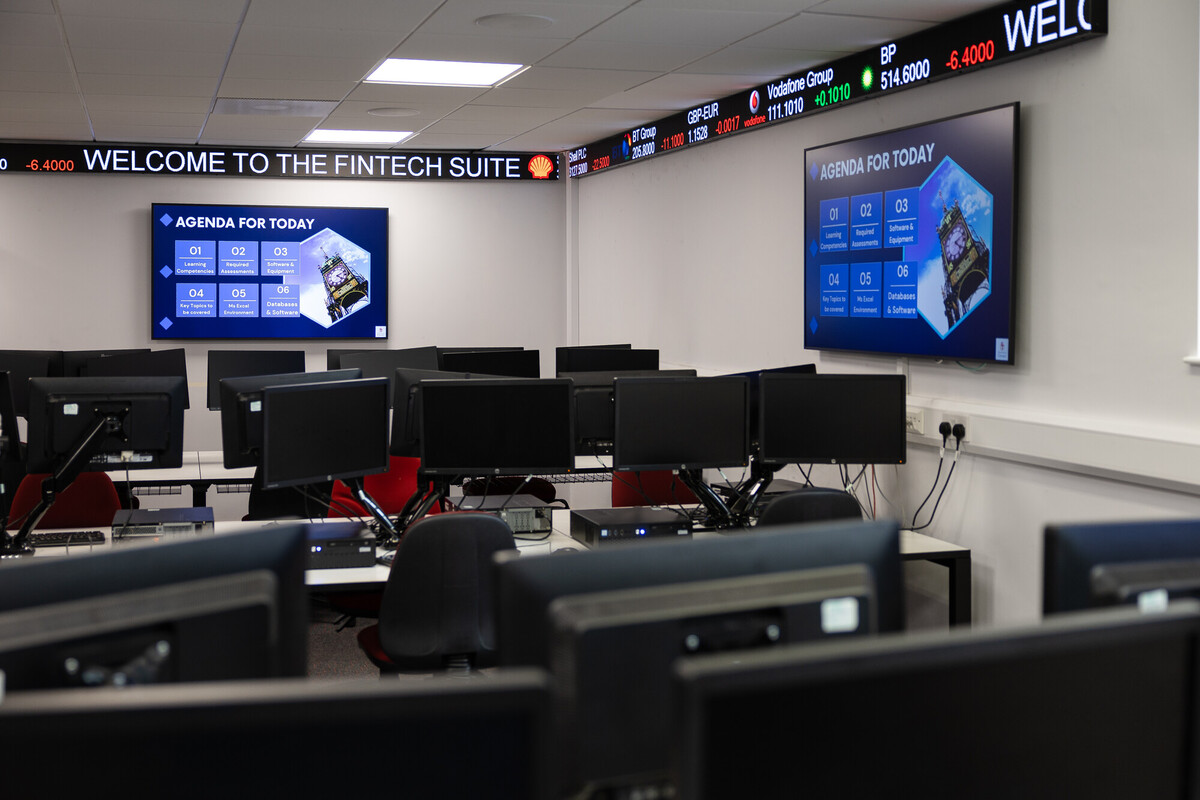

Two students sitting at computer screens in the Fintech Suite

Course Overview

Read summary

Economics and FinTech BSc Hons at Chester:

  • will enable you to develop analytical, quantitative, digital, and problem-solving skills alongside professional, ethical, and intercultural awareness
  • places a strong emphasis on employability and professional development, including dedicated employability modules
  • will prepare you for a career in financial services, FinTech organisations, banking, investment analysis, economic consultancy, business intelligence, policy analysis, data analytics, or related sectors.

The Economics and FinTech BSc (Hons) course equips you with a comprehensive understanding of:

  • economic theory
  • financial systems
  • quantitative analysis
  • emerging technologies that are transforming the global financial sector.

Our curriculum is designed to develop graduates who can:

  • critically analyse economic and financial challenges
  • apply advanced analytical techniques
  • leverage innovative technologies to support decision-making in an increasingly digital economy.

The curriculum fosters intellectual curiosity, adaptability, and lifelong learning, preparing graduates to contribute responsibly to the future of financial services and economic development.

Our course also provides a strong foundation for postgraduate study and professional development in economics, finance, technology, and interdisciplinary fields.

*Subject to approval.

In Year 1, you'll study at Exton Park, enjoying new Business teaching spaces and the full benefits of the University's central campus. In Years 2 and 3, you'll move to Queen's Park, home to our award-winning Business School.


Course Highlights

Course Content

The Economics part of the course is underpinned by an incremental approach to learning, starting with Introductory Micro and Macroeconomics in Year 1 and finishing with Advanced Micro and Macroeconomics in Year 3. This element is supported by a range of highly contemporary, specialised and technical FinTech modules (some of this teaching will be delivered using the FinTech Labs).

The course begins by establishing a strong foundation in microeconomics and macroeconomics, enabling you to understand how markets, institutions, businesses, and governments interact within national and international contexts.

You are also introduced to the principles of Financial Technology (FinTech), exploring the impact of digital innovation on financial products, services, and business models. Quantitative methods provide the mathematical and statistical tools necessary for analysing financial data and supporting evidence-based decision-making.

You will also develop broader professional competencies through optional study in areas such as organisational behaviour and people management, and may enhance your global outlook through the study of a modern foreign language.

Core Modules

This module is designed to provide you with an introductory understanding of the key principles and concepts of micro and macroeconomics and their application. This is set within the contemporary social, political, financial and policy context, particularly post the financial crisis. This is to enable you to appreciate the relevance of economics within a wider context. It will also provide guidance on how to approach the study of economics related concepts, and how to start thinking like an economist as well as developing more of generic skills such as economy related presentations.

Microeconomics content includes:

  • Basic economic problems of scarcity and choice
  • How consumers and producers make decisions
  • Implications of different market structures
  • Economic welfare
  • How governments intervene when markets fail

Macroeconomics content includes:

  • Wider economic environment, including the measurement and flows of national income
  • Causes and effects of unemployment and inflation
  • Uses and abuses of government fiscal and monetary policy

 Content relating to the application of the above includes:

  • Impact of government macro and microeconomic policies on society
  • Impact of fiscal, monetary issues and financial markets on society
  • Public expenditure, employment, labour markets, labour relations and income distribution and implications
  • Austerity and post-crisis welfare

This module provides a comprehensive and integrated introduction to the field of Financial Technology (FinTech) within the context of the BSc Economics and FinTech degree. It is designed as the foundational anchor for the course, building the conceptual, technical and analytical literacy that you will require for advanced study at Levels 5 and 6.

You will develop an understanding of the economic drivers of digital disruption, the core technologies underpinning modern financial systems, and the regulatory and ethical environment in which FinTech operates.

The module is structured around eight thematic sections:

  • The FinTech Landscape and Economic Disruption

  • Digital Assets, Blockchain and Decentralised Finance

  • Digital Infrastructure: Payments, Banking and Alternative Finance

  • Data Literacy and Computational Thinking

  • Applied FinTech Sectors

  • Regulation, Risk and Ethics

  • FinTech, Society and the Economy

  • Innovation, Entrepreneurship and the Path Forward

The module concludes with a synthesis project in which you will integrate knowledge from across all sections to propose a FinTech solution to a defined economic or social problem, preparing you directly for the AI and advanced modelling content delivered at Levels 5 and 6.

This module will equip you with the essential skills to analyse, interpret, and present data effectively within a professional setting. It focuses on developing numerical literacy, critical thinking, and problem-solving abilities.

This module has the intention of enabling you to address workplace challenges with evidence-based decisions in organisations. Core areas of interest covered within this module include basic statistical analysis, investment decisions, financial reasoning, application of numerical tools, data presentation and interpretation, capital rationing techniques.

The intention is to bridge theoretical knowledge and practical applications to prepare you to use data to enhance the quality of decision making within the organisation.

Optional Modules

The module explores a number of key themes to introduce students to the concepts of people management and organisations and supports students to develop core skills for managing people and working in teams.  

  • The development of management and organisations as subjects - changing theories of management and leadership perspectives.
  • People in organisations – indicative content: motivation, culture, personality, identity, how people work in groups and effective teamworking, learning in an organisational context.
  • Managing people in organisations - indicative content: organisation and job design, talent management, goal setting, communication, perception and the psychological contract, job satisfaction, stress.
  • Skills for managing people in teams and organisations - indicative content: team formation, team working and leading, managing performance, giving feedback, managing conflict.

Optional Language Modules

This module is designed for students that have completed an A-Level or equivalent in Spanish. You will further develop your grammar, vocabulary and expression and apply these to real world situations. You will work with written and recorded texts on a range of cultural, personal and social topics and will develop oral and written communication skills at Post-A level.

This module is designed for students who have completed GCSE or equivalent in French. You will further develop your grammar, vocabulary and learning conventions for spelling and pronunciation. You will work with written and recorded texts on a range of cultural, personal and social topics and will develop oral and written communication skills at an intermediate level.

This module is designed for students that have completed GCSE or equivalent in Spanish. You will further develop your grammar, vocabulary and learning conventions for spelling and pronunciation. You will work with written and recorded texts on a range of cultural, personal and social topics and will develop oral and written communication skills at an intermediate level.

This module is designed for students who have completed GCSE in Chinese or equivalent. You will further develop your grammar, vocabulary and learning conventions for spelling and pronunciation. You will work with written and recorded texts on a range of cultural, personal and social topics and will develop oral and written communication skills at an intermediate level.

This module enables students with A-Level German or equivalent to further develop their grammar, vocabulary and expression and apply these to real world situations.You will work with written and recorded texts on a range of cultural, personal and social topics and will develop your oral and written communication skills at Post-A level.

This module is designed for students that have completed A-Level or equivalent in French. You will further develop your grammar, vocabulary and expression and apply these to real world situations. You will work with written and recorded texts on a range of cultural, personal and social topics and will develop your oral and written communication skills at Post-A level.

The information listed in this section is an overview of the academic content of the course that will take the form of either core or option modules and should be used as a guide. We review the content of our courses regularly, making changes where necessary to improve your experience and graduate prospects. If during a review process, course content is significantly changed, we will contact you to notify you of these changes if you receive an offer from us.

The curriculum places a strong emphasis on employability and professional development. Dedicated employability modules enable you to reflect on your skills, career aspirations, and professional identity, while opportunities for work placement allow you to apply your knowledge in real-world organisational settings.

Core Modules

This module is designed to build upon the principles of microeconomics and macroeconomics introduced at Level 4 by developing a deeper understanding of economic theory and its application to contemporary economic and policy issues. You will critically evaluate economic models, analyse real-world economic problems, and apply economic reasoning to assess government policies and business decisions in national and international contexts. The module places greater emphasis on analytical thinking, quantitative reasoning, and evidence-based policy evaluation, preparing you for advanced study in economics, finance, and related disciplines.

Microeconomics content includes:

  • Consumer choice and utility maximisation.

  • Producer behaviour, production, costs, and profit maximisation.

  • Market structures, competition, monopoly, and strategic behaviour.

  • Game theory and firms' strategic decision-making.

  • Labour markets, factor pricing, and income determination.

  • General equilibrium and welfare economics.

  • Externalities, public goods, asymmetric information, and market failure.

  • Government intervention, regulation, taxation, and competition policy.

Macroeconomics content includes:

  • National income determination and macroeconomic equilibrium.

  • Inflation, unemployment, and economic growth.

  • Business cycles and economic fluctuations.

  • Monetary systems and financial markets.

  • Fiscal policy, monetary policy, and macroeconomic stabilisation.

  • Exchange rates, international trade, and open-economy macroeconomics.

  • Public debt, government expenditure, and long-run fiscal sustainability.

  • Contemporary macroeconomic challenges, including financial crises, inflationary pressures, inequality, and sustainable economic growth.

Content relating to the application of the above includes:

  • Critical evaluation of competing economic theories and policy perspectives.

  • Application of economic models to contemporary economic, financial, and public policy issues.

  • Analysis of government interventions and their implications for markets, businesses, and society.

  • Evaluation of the economic impacts of financial crises, globalisation, technological change, and digital transformation.

  • Interpretation of empirical evidence and economic data to support policy analysis and decision-making.

  • Development of analytical, quantitative, and communication skills through problem-solving, case studies, and policy discussions.

This module builds upon earlier modules in business, data analysis, or related disciplines with a view to introducing you to topics that both advance their understanding of modern technological applications and have practical use across various industry sectors. The module will be looking at contemporary, real-world applications of artificial intelligence and will try to include employer participation to keep the learning practical.

The module will include:

  • AI, Big Data, and Business Datasets: Exploring how large-scale datasets are collected and analysed using AI.

  • Agent-Based Modelling and Business Situation Simulation: Simulating real-world scenarios to see how different factors interact.

  • Computer Vision for Trend Analysis: Using visual data and image recognition to identify market trends.

  • Generative AI for Market Intelligence and Research: Applying generative tools to gather insights and conduct market research.

  • Sentiment Analysis: Analysing text to understand market moods and public sentiment.

  • Robotic Process Automation (RPA) in Operations: Learning how to automate everyday business tasks and workflow operations.

This module provides essential data science skills and applications tailored for undergraduate economics students. It introduces foundational and advanced econometric techniques, building on students' statistical skills and proficiency with software applications. The module focuses primarily on supervised learning, including running regressions using Ordinary Least Squares (OLS) and maximum likelihood estimation. To address different economic questions, students will complete regression analyses using cross-sectional, time-series, and panel data. The module also covers the use of instrumental variables (IV) and quasi-experimental approaches, integrated within Stata and RStudio software. Additionally, students will be introduced to other key components of data science, such as unsupervised learning, with brief explorations in Python and Google Colab.

This module seeks to: 

  1. Provide students with an analytical framework for understanding complex global financial markets
  2. Explore the key drivers of financial market activity (in debt, equity and FX markets)
  3. Analyse available risk management strategies for market participants.  
  4. Understand the role of central banks and other market regulators. 

It will cover topics such as, but not limited to:

  1. The importance of financial markets in the economy through the efficient allocation of capital 
  2. Financial intermediation and the evaluation of key driving factors shaping the financial markets
  3. Critical evaluation of risk management strategies (liquidity, interest rate and credit risk) within financial institutions and the effect these have on profitability
  4. Monetary policy, and the links to economics and financial markets. 
  5. Regulation of financial markets and institutions and management of financial crises.

Optional Modules

This module is designed to enhance student’s professional skills in a real-world job setting and is structured to bridge theory and practice, featuring engagement with industry through guest lectures, business networking and practical case study applications. It will enhance student’s practical skills and broaden their professional networks, aligning with the university's goal of preparing students for impactful graduate careers.

It will provide learners with hands-on experience of real-world scenarios in the finance sector and help them understand business expectations on them as professionals, build confidence, and prepare them for the world of work.   

The module will also enhance students’ knowledge of the graduate employment market focussing them on developing their employability skills and build a comprehensive toolkit of skills and knowledge to enable them to stand out from the crowd and achieve success in finding graduate employment.

This module provides a structured, university-level work placement for 5 weeks as one continuous block / period with a placement provider (i.e. a local employer from the private, public, or charitable sector). It is designed to enhance your professional skills in a real-world job setting.  

The placement can either be organised by you or with support from university staff.  

All work placements within this module must be university-level; this means:  

  • Undertaking high-skilled work commensurate with level 5 study (e.g. report writing, attending meetings, delivering presentations, producing spreadsheets, writing content on webpages, social media, marketing services/products etc)  
  • Physically placed (albeit part of it can be hybrid) within an employer setting in one continuous block / period for 5 weeks for a minimum of 140-147 hours over the course of the entire work placement 
  • Where applicable, your existing part-time employer can be approached/used as the placement provider, if the high-skilled work criterion above is fulfilled for the full duration of the placement.   
  • All quality assurances/agreements provided by the University are adhered to, by you and the employer.  

The work placement context may not necessarily, reflect your degree discipline per se, but rather, it will give you an enriched experience to enhance your professional skills in a real-world job setting. 

Optional Language Modules

This module is designed for Level 5 students of all disciplines interested in Teaching English to Speakers of Other Languages. You will develop your language awareness and acquire a basic understanding of the communicative approach to teaching English as a Foreign Language. You will also be introduced to a range of techniques for lesson planning, teaching practise and assessment. This knowledge will be applied practically in the planning of interactive learning activities and lesson structures, utilising the loop input approach. You will also be acquainted with a variety of language learning resources. As this is a practical and developmental course, you will be required to use the techniques taught in planning and delivering short lessons, which you will reflect on and develop for future sessions.

The module will provide the opportunity to further develop your language skills, building on your previous learning at advanced level. The second half of the module includes a placement abroad or, alternatively, a project on a sustainability issue in a target language country. The first half of the module will prepare you for placements abroad where appropriate as well as a deeper understanding of sustainability in target language contexts. Students of more than one language may take one language in the first half of the module and spend their time abroad developing a different language. 

The module will provide the opportunity to further develop your language skills, building on your previous learning at beginner level. The first half of the module includes intensive taught sessions in interactive workshop mode which will prepare you for placements abroad or self-directed language development. The second half of the module includes a placement abroad or, alternatively, a project on a cultural issue in a target language country. Students of more than one language may take one language in the first half of the module and spend their time abroad developing a different language. 

  • The multiple facets of global citizenship
  • Ethical engagement and practice
  • The United Nations Sustainable Development Goals
  • Cross-cultural issues and sensitivity
  • Intercultural communication
  • Culture shock
  • Cultural adjustment
  • Self- assessment of needs: identification of the range of transferable skills, competencies and attitudes employees need and employers expect graduates to possess-with a strong focus on understanding the intercultural competencies (ICC) needed to live and work abroad.
  • Critical analysis/evaluation of individual requirements in relation to culture/cultural adjustment/culture shock/visas/medical.
  • Critical analysis/evaluation of skills already acquired in relation to key skills related to ICC.
  • Devising strategies to improve one’s own prospects of working abroad in the future.
  • Devising an action plan to address gaps in transferable skills based on organisational analysis and sector opportunities.

The information listed in this section is an overview of the academic content of the course that will take the form of either core or option modules and should be used as a guide. We review the content of our courses regularly, making changes where necessary to improve your experience and graduate prospects. If during a review process, course content is significantly changed, we will contact you to notify you of these changes if you receive an offer from us.

In the final stage of the course, you will integrate your learning through advanced modules in economics, FinTech, and data analysis for decision-making.

Core Modules

This module builds upon earlier modules in microeconomic and macroeconomic theory with a view to introducing you to topics that both advance their understanding of the foundations of economic analysis and have applications across a range of social science and management disciplines, and developing their criticality.  The module will be looking at contemporary applications and will try to include employer participation.

At the micro-level, the module will include:

  • Market power and pricing strategies

  • Investment, time and insurance

  • Risk and uncertainty analysis

  • Asymmetric information

  • Behavioural and experimental economics

At the macro-level, the module will include:

  • Trade-off between inflation and unemployment

  • Dynamic aggregate supply and demand

  • Understanding consumer behaviour

  • The theory of investment

  • Stabilization policies

  • Government debt and budget deficits

  • Macroeconomics and the global financial crisis

Applied Econometrics develops advanced quantitative skills for analysing economic and financial data, with a particular emphasis on financial technology (fintech), digital finance, and modern empirical research methods. The module combines econometric theory with practical applications, enabling you to evaluate contemporary issues in financial economics using real-world data and rigorous causal inference techniques.

The module explores how econometric methods can be used to investigate key questions in fintech and financial markets, including digital payments, mobile banking, peer-to-peer lending, financial inclusion, digital currencies, platform finance, artificial intelligence in finance, financial innovation, credit markets, and the economic impacts of emerging financial technologies. Through these applications, you will learn how empirical evidence can be used to inform business strategy, financial regulation, and public policy.

A central feature of the module is the identification of causal relationships rather than simple statistical associations. You will be introduced to modern causal inference methodologies widely used in economics and finance, including panel data models, fixed-effects estimation, instrumental variables, difference-in-differences, regression discontinuity designs, matching methods, and event-study approaches. The module emphasises the assumptions underlying each identification strategy and develops your ability to critically evaluate empirical research and interpret causal evidence.

Alongside methodological training, you will develop practical skills in managing and analysing large-scale datasets using professional statistical software. They will learn data preparation, model estimation, diagnostic testing, interpretation of empirical results, and effective communication of quantitative findings through applied research projects. By integrating contemporary fintech applications with state-of-the-art econometric techniques, the module equips you with the analytical and empirical skills required for careers in finance, fintech, consulting, policy analysis, and economic research.

This module builds upon earlier modules in programming, data analytics, and foundational finance with a view to introducing you to cutting-edge tech topics that both advance their understanding of modern financial systems and have direct applications across digital platforms, quantitative analysis, and tech-driven decision-making. The module will focus heavily on contemporary, practical applications of AI and data science, and will actively try to include industry and employer participation.

The module will include:

  • Deep Learning for Intelligent Prediction – Utilising advanced techniques to forecast large-scale business trends and market movements.

  • Data Mining and Structural Pattern Recognition – Identifying hidden regimes and structural shifts within massive business datasets.

  • Algorithmic Dynamic Modelling for Digital Economies – Simulating, testing, and building systems for fast-evolving digital markets and web-based platforms.

  • Reinforcement Learning in Decision-Making – Training intelligent AI agents to execute optimal strategies and automated financial choices.

  • Vibe Coding and Quantitative Behavioural Analysis – Using rapid, LLM-assisted development (vibe coding) to track, model, and capitalise on market sentiment and user behaviour.

This module is going to focus on primary, secondary and mixed data and how using data analysis can support decision making. It will equip students with essential skills to analyse, interpret, and present data effectively in professional settings. Equip students with the relevant practical skills through the application of advanced Ms Excel techniques and SPSS usage, to analyse variables to address decisions. Provide students with the critical skills required to collect and analyse data; and its presentation by means of relevant methods. 

Data - databases (such as FAME, Yahoo Finance and Investing.com), types of financial data with emphasis on big data, ethics in data handling, annual reports and other source. Data in SPSS - Entering data into SPSS, measuring and setting variables. 

Data mining - Data Visualisation Techniques in Excel-creation of dashboards using pivot tables, lookups and logical statements, use financial ratios to conduct performance analysis of companies with data on available databases.

Data Collection - Exploring techniques and tools for primary data collection and methods to analyse for understanding and presentation. Transferring and exporting collected data into Excel and SPSS for data analysis. 

Financial Statistics in Excel - use the 'Analysis ToolPak' -  and SPSS, descriptive statistics (mean, median, mode, standard deviation and variance), Anova (single factor, 'with and without' replication), correlations, regressions, T-Test, and Excel solver (for linear programming).

Financial Markets - market sensitivity (beta estimation), portfolio diversification (variance and covariance matrix), market reaction to announcement (event study-single and multiple events), market efficiency (use time series models such auto-regression and moving average concepts).

The module is designed to enable students to develop and apply business research and analytical skills that will enhance their employability and rapid progression to management positions in the workplace. It requires them to: 

  • Undertake a research project that is 'scoped and framed' within a required degree programme of study.
  • Design and conduct appropriate in-depth research in an elected area of study.
  • Acquire, consolidate and apply theoretical knowledge, methodologies, and research approaches in a ‘real world’ environment.
  • Develop and utilise skills in critical investigation; analysis and synthesis of evidence; reflection and autonomous learning.

The information listed in this section is an overview of the academic content of the course that will take the form of either core or option modules and should be used as a guide. We review the content of our courses regularly, making changes where necessary to improve your experience and graduate prospects. If during a review process, course content is significantly changed, we will contact you to notify you of these changes if you receive an offer from us.

Teaching and Assessment

You will learn through a mixture of:

  • taught face-to-face lectures
  • group work
  • presentations
  • self-directed learning outside of the classroom environment.

Class sessions will include:

  • tutor presentations
  • individual exercises
  • group case study work
  • group problem solving work
  • extensive class discussions.

All class materials will be available on the Virtual Learning Environment of the University. It is also worth noting that, extensive reading of texts and journals will be required as befits degree-level modules. You will be given tutor guidance and direction in navigating the required resources linked to this course.

The value of developing your ability to work and learn on your own is recognised. The skill set required for meeting this need has been accordingly embedded within the modules of this course. Again, to facilitate the development of this, emphasis is placed on shared responsibility for learning, on the importance of independent work to support the tutor-led sessions and on student self-directed learning.

You will also be taught in a social, inclusive, flexible and accessible learning environments, using online tools in classrooms and other subject-specific spaces and locations.

Finally, your independent learning is particularly developed within the 40-credit dissertation, and it is appropriate that this element occurs in the latter half of the course. You would have had the opportunity to develop appropriate academic skills, knowledge and understanding in the earlier stages of the course to meet this requirement.

You will be assessed in authentic ways that motivate, and both support your wellbeing and future employer or professional expectations. This is a strategy to develop your future-focused skills to meet your diverse personal and professional ambitions.

Career Prospects

Careers Service

Careers and Employability support at the University of Chester helps you plan your future, make the most of your time at university and enhance your graduate prospects.

We provide access to part-time jobs, extra-curricular employability-enhancing workshops and practical one-to-one help with career planning, including help with CVs, applications and mock interviews.

Support goes well beyond graduation at Chester, offering lifelong careers advice and graduate support, so you won’t just leave with a degree – you’ll leave prepared, connected and ready for success.

Academic Staff

Dr Paul Cowley

Senior Lecturer
profile picture of lecturer Dr Paul Cowley

Entry Requirements

112UCAS points

UCAS Tariff

112 points

GCE A Level

Typical offer – BCC-BBC

BTEC

BTEC Extended Diploma: DMM

International Baccalaureate

28 points

Irish / Scottish Highers

Irish Highers - H3 H3 H3 H3 H4

Scottish Highers - BBBB

Access requirements

Access to HE Diploma, to include 45 credits at level 3, of which 30 must be at Merit or above

T Level

Merit

OCR Cambridge Technicals

OCR Extended Diploma: DMM

Extra Information

Welsh Baccalaureate Advanced and A level General Studies will be recognised in our offer. We will also consider a combination of A Levels and BTECs/OCRs.

Interview

All applicants will complete a standard application form and may be invited to attend an informal interview when feasible to do so.

Students from outside the UK are expected to hold qualifications broadly equivalent to UK standards - typically A Level for undergraduate study.

To help you interpret these equivalents, please select your country/region of residence. This will provide details on equivalent entry requirements, as well as information about local representatives, events, and key contacts.

We accept a wide range of qualifications and assess all applications on an individual basis. Relevant work experience may also be taken into consideration where appropriate.

For more information on English entry requirements, including accepted qualifications, please visit International Entry Requirements.

English Language Requirements

IELTS

IELTS Academic: Undergraduate: 6.0 (minimum 5.5 in each band)

Fees and Funding

£9,790per year for a full-time course (2026/27)

Tuition fees for Home students for the academic year 2026/27 will be £9,790 for full-time students and £7,335 for part-time students (subject to Parliamentary approval). Fees for subsequent years may be subject to increase in line with the Government fee cap.

You can find more information about undergraduate fees on our Fees and Finance pages.

Students from the UK, Isle of Man, Guernsey, Jersey and the Republic of Ireland are treated as Home students for tuition fee purposes.

Students from countries in the European Economic Area and the EU will pay International Tuition Fees.

Students who have been granted Settled Status may be eligible for Home Fee Status and if eligible will be able to apply for Tuition Fee Loans and Maintenance Loans.

Students who have been granted Pre-settled Status may be eligible for Home Fee Status and if eligible will be able to apply for Tuition Fee Loans.

£14,950*per year for a full-time course (2026/27)

The tuition fees for international students studying Undergraduate programmes in 2026/27 are £14,950 per year for a full-time course. This fee is set for each year of study.

The University of Chester offers generous international and merit-based scholarships, providing a significant reduction to the published headline tuition fee. You will automatically be considered for these scholarships when your application is reviewed, and any award given will be stated on your offer letter.

For courses with a Foundation Year, the tuition fees for Year 1 are £11,250 and £14,950 for Years 2-4 in 2026/27.

For more information, go to our International Fees, Scholarship and Finance section.

Irish Nationals living in the UK or ROI are treated as Home students for Tuition Fee Purposes. 

Your course will involve additional costs not covered by your tuition fees. This may include books, printing, photocopying, educational stationery and related materials, specialist clothing, travel to placements, optional field trips and software. Compulsory field trips are covered by your tuition fees. 

If you are living away from home during your time at university, you will need to cover costs such as accommodation, food, travel and bills.

The University of Chester supports fair access for students who may need additional support through a range of bursaries and scholarships. 

Full details, as well as terms and conditions for all bursaries and scholarships can be found on the Fees and Finance section of our website.

Connectwith us